JP Nagar, Bangalore-78
+91 89046 66442 | 88822 61858
Morning: 8:00 AM – 9:00 AM | Evening: 5:30 PM – 9:00 PM
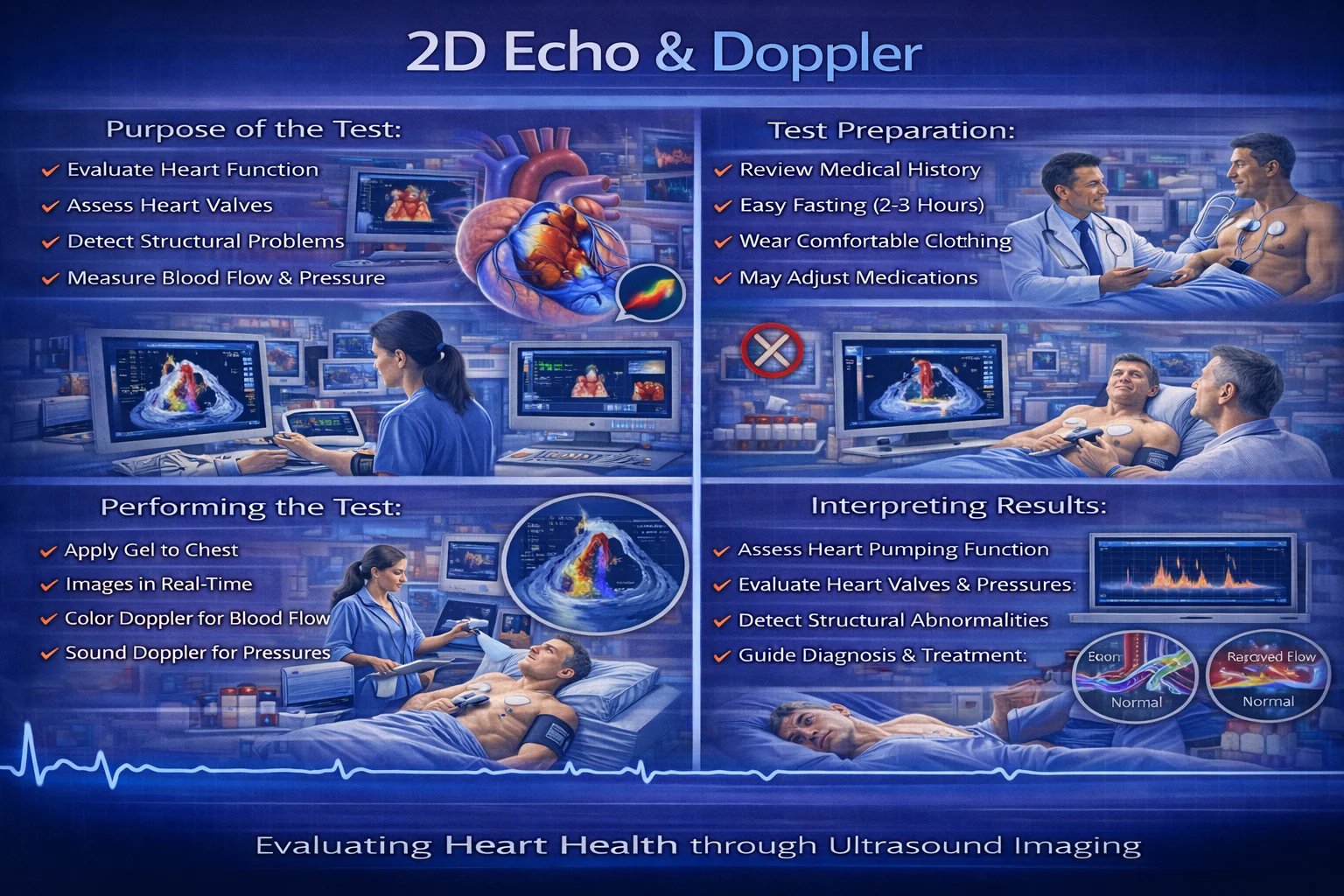
2D Echocardiography (2D Echo) and Doppler ultrasound are non-invasive diagnostic tests used to evaluate the structure and function of the heart. These imaging techniques provide detailed views of the heart’s chambers, valves, and blood flow, helping healthcare providers diagnose a wide range of heart conditions. 2D Echo gives real-time images of the heart, while Doppler ultrasound measures the speed and direction of blood flow, providing essential information for detecting heart abnormalities, valve dysfunction, and cardiovascular diseases.
2D Echocardiography (2D Echo) is a form of ultrasound that uses sound waves to create two-dimensional images of the heart. The images provide detailed information about the heart’s structure, including the size and function of the heart chambers, the heart valves, and the walls of the heart. It also helps detect abnormalities such as heart enlargement, valve problems, and congenital heart defects.
Doppler ultrasound is a specialized technique used during an echocardiogram to assess the blood flow within the heart. It measures the velocity of blood flowing through the heart’s chambers, arteries, and valves, allowing doctors to identify any blockages, abnormalities, or areas of turbulence. This information is critical for diagnosing conditions like heart valve disease, arrhythmias, and congenital heart defects.
2D Echo & Doppler are essential tools in cardiovascular diagnostics for several reasons:
Comprehensive Heart Evaluation: These tests provide a detailed view of both the structure and function of the heart, helping identify any underlying issues that could lead to heart disease or complications.
Non-Invasive and Painless: Both tests are completely non-invasive and painless, making them safe and easy to perform without the need for surgery or injections.
Early Detection of Heart Conditions: 2D Echo & Doppler are effective in detecting heart conditions early, such as heart valve disease, heart failure, and congenital heart defects, before they become more severe.
Guiding Treatment Decisions: These tests help healthcare providers develop accurate treatment plans for heart conditions, whether through lifestyle changes, medications, or procedures like valve repair or replacement.
2D Echo & Doppler are often recommended in the following situations:
Chest Pain: If you experience unexplained chest pain or discomfort, these tests help determine if the heart is the cause.
Shortness of Breath: Difficulty breathing during physical exertion or at rest can be a sign of heart disease, and these tests can help identify the underlying cause.
Heart Murmurs: If your doctor hears an abnormal heart sound (murmur), 2D Echo & Doppler can help assess the heart valves and blood flow.
Heart Valve Issues: If you have symptoms of heart valve disease, such as fatigue or swelling, these tests provide detailed images of the valves and assess their function.
Abnormal Heart Rhythms: Doppler ultrasound helps assess blood flow and detect irregular heart rhythms (arrhythmias).
Heart Failure: 2D Echo is used to evaluate heart function in patients with suspected or diagnosed heart failure.
Congenital Heart Defects: These tests are also used to diagnose congenital heart defects, particularly in children or adults with a family history of heart disease.
The procedure for 2D Echo & Doppler is straightforward and generally involves the following steps:
Preparation: You may be asked to change into a hospital gown, but no special preparation is required beforehand. It is typically performed while you are lying on your back or left side.
Electrode Placement: Small electrodes will be placed on your chest to record the electrical signals of your heart during the test. These electrodes help guide the echocardiogram and Doppler measurements.
Ultrasound Gel: A special gel is applied to your chest to help transmit the sound waves from the ultrasound probe.
Transducer Movement: A small device called a transducer is placed on your chest. This device emits high-frequency sound waves that bounce off your heart and return to the machine, which creates real-time images of the heart’s structures.
Doppler Ultrasound: The Doppler ultrasound component uses the same device to measure blood flow. It detects changes in the frequency of sound waves as they bounce off moving red blood cells, which helps measure the speed and direction of blood flow within the heart’s chambers and blood vessels.
There are several key benefits of 2D Echo & Doppler for diagnosing and managing heart conditions:
Comprehensive Heart Health Evaluation: These tests provide detailed information about heart structure and function, which is essential for diagnosing conditions like valve disease, heart failure, and arrhythmias.
Early Detection of Problems: 2D Echo & Doppler can detect issues like heart valve leakage, blockages, or congenital defects at an early stage, allowing for timely treatment.
Non-Invasive: The tests are non-invasive, meaning no surgery or injections are required. They are safe, quick, and painless procedures.
Real-Time Data: The tests provide real-time images and measurements, allowing for immediate analysis and quicker diagnosis.
Guiding Treatment and Monitoring: 2D Echo & Doppler help healthcare providers guide treatment decisions, monitor progress, and assess the effectiveness of treatments for various heart conditions.
While 2D Echo & Doppler are generally safe, there are a few considerations to keep in mind:
Mild Discomfort: Some patients may experience mild discomfort when the transducer is pressed against the chest, particularly if there is pre-existing chest tenderness.
Not Suitable for All Patients: In rare cases, the images or Doppler readings may be difficult to obtain due to obesity or other physical factors. In such cases, additional imaging techniques may be necessary.
Once the test is completed, your doctor will review the results and discuss any findings. Depending on the results, further diagnostic tests or treatments may be recommended, including:
Lifestyle Changes: Recommendations for dietary changes, exercise, and stress management to improve heart health.
Medications: Prescription medications to control blood pressure, cholesterol, or blood flow, depending on the condition.
Surgical Procedures: If significant valve problems or heart defects are detected, surgical intervention may be necessary to repair or replace a valve.
If you are experiencing symptoms such as chest pain, shortness of breath, fatigue, or irregular heartbeats, or if you have a family history of heart disease, scheduling a 2D Echo & Doppler test can provide crucial insights into your heart health. Call us today at +91 8904666442 to book your appointment and take the next step toward maintaining a healthy heart.



Consultant Interventional Cardiologist
MBBS, MD, DM, FICC, FSCAI (USA)